
» The Next COVID-Like Crisis May Not Be Biological
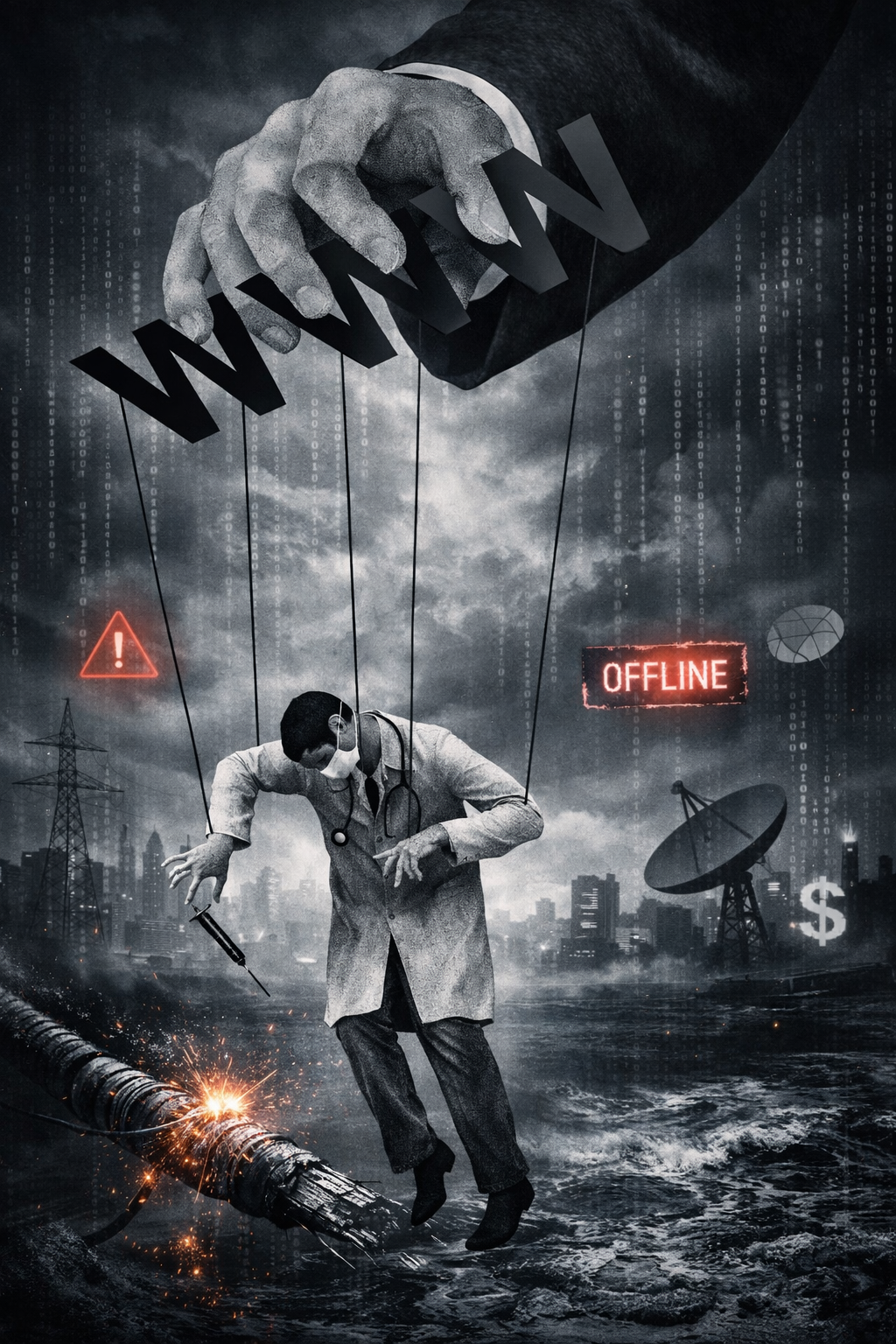
PM Modi’s Warning, Local AI, Cybersecurity, Internet Instability, and the Future of Resilience
By Subham Ojha | The Psychepreneur
Most people search for the future in the shape of the past.
That is the first mistake.
They assume the next COVID-like event will look like another virus, another lockdown, another public-health emergency, another familiar cycle of panic and adaptation.
I do not think so.
I think the next global shock may be far more dangerous precisely because it may not begin in biology at all.
It may begin in systems.
And when PM Modi warns the country to stay prepared the way it did during COVID, while speaking in the broader context of cyber risk, strategic security, infrastructure, and prolonged global instability, I do not hear a routine political statement.
I hear a signal.
I hear a warning that the next era of disruption may not come through the body first.
It may come through the infrastructure that modern life quietly depends on every single day.
I’m Subham Ojha, and through The Psychepreneur, I spend a lot of time thinking about what the world overtrusts. Not just trends. Not just AI hype. Not just startup noise. I look at the invisible assumptions beneath modern life.
The cloud will always be reachable.
The internet will always be available.
The payment rails will always clear.
The supply chain will always move.
The platform will always respond.
The system will always hold.
That is the illusion.
And I believe the next COVID-like crisis may be the moment that illusion breaks.
My core prediction
The next global shock may not be biological.
It may be digital, infrastructural, and systemic.
Not a virus first.
A systems fracture first.
A large-scale cyber attack.
Internet instability.
An undersea cable disruption.
Energy route breakdown.
Payment rail failures.
Cloud concentration risk.
Supply chain slowdown.
A coordinated disinformation layer amplifying panic on top of all of it.
A blended systems shock.
That is my actual prediction.
Not one clean event.
Multiple fractures at once.
And that is exactly what would make it feel COVID-like.
Because what made COVID historic was not just the virus itself.
It was the speed at which it forced the entire world to change behavior.
The next event may do the same thing, but through a different attack surface.
Prediction 1: The next COVID-like event will likely be a systems crisis, not a health crisis
This is the main point.
The next major disruption could begin with infrastructure, not infection.
That means the world may get hit by a chain reaction across:
- cybersecurity
- digital infrastructure
- internet access
- logistics
- energy
- cloud dependency
- payments
- trust in institutions and systems
The average person will not describe it using terms like “systems fragility” or “cyber-physical disruption.”
They will just experience it as this:
things that were supposed to work… stop working smoothly.
Apps lag.
Payments fail.
Logistics slows.
Costs rise.
Networks fragment.
Confusion spreads.
Trust drops.
And once trust drops faster than systems recover, behavior changes fast.
That is when a disruption becomes civilization-level.
Prediction 2: The world will realize how fragile always-online life actually is
Right now, the world is addicted to convenience.
We live inside subscriptions.
We work inside cloud apps.
We store our intelligence in remote systems.
We assume permanent connectivity like it is a law of physics.
It is not.
Modern life is built on a dangerous silent belief:
the network will always be there.
And I think the next major crisis may expose just how weak that assumption really is.
That changes everything.
Because once the world experiences even partial internet instability or digital infrastructure stress, the market starts revaluing a very different set of things:
reliability over elegance
continuity over convenience
ownership over dependency
resilience over speed
That shift will not be philosophical.
It will be immediate.
Prediction 3: The next big shift will be from cloud-first to continuity-first
For years, the world rewarded cloud-first architecture.
And that made sense.
Cloud gave scale.
Subscriptions gave access.
Centralization gave convenience.
Everything felt lighter, faster, cheaper, more flexible.
Until the environment becomes hostile.
That is the part most people still do not understand.
The systems that look beautiful in stable conditions often look brittle in unstable ones.
And that is why I believe the next major strategic shift will not just be about digital transformation.
It will be about continuity-first architecture.
The question will no longer be:
Can your product scale?
It will become:
Can your product still function when the network weakens, the vendor becomes unreliable, or the infrastructure layer gets stressed?
That one question will reshape software, product strategy, cybersecurity, and digital infrastructure.
Prediction 4: Offline-first and local-first systems will stop being niche ideas
Today, most people treat offline-first apps, local-first software, delayed sync, local caching, peer-to-peer fallback, and graceful degradation as advanced product design choices.
Tomorrow, they may become survival features.
That is a big shift.
In a resilience-first world, the products that win will not just be the ones with the best features.
They will be the ones that can:
- keep working with weak internet
- reduce cloud dependence
- hold local state
- sync later
- recover cleanly
- support continuity during disruption
That changes what “good product” means.
It also changes what investors, enterprises, and governments start valuing.
Because in unstable conditions, software is no longer judged only by UX.
It is judged by survivability.
Prediction 5: Local AI and local LLMs will become strategically more important than most people think
This is where I think the market is still early.
Right now, the world is comfortable renting intelligence.
ChatGPT.
Claude.
Gemini.
Copilots.
Cloud-based AI.
Monthly subscriptions.
Always-online intelligence.
That model has become normal.
But one serious internet outage, cyber event, or infrastructure shock, and people begin asking a much more serious question:
What happens when the intelligence I rely on lives somewhere else, and I cannot reliably reach it?
That is where local AI, local LLMs, AI PCs, edge AI, and on-device inference become far more valuable.
Not as a nice-to-have.
As strategic capability.
Because in a stressed world, the question will not only be:
Which model is smartest?
It will become:
Which intelligence stack still works when the system around it becomes unstable?
That is a different future.
And it is one that benefits:
- local AI
- Nvidia AI PCs
- edge compute
- on-device copilots
- enterprise-local LLM deployments
- private knowledge systems
- offline-capable AI workflows
That is not just an AI trend.
That is a resilience thesis.
Prediction 6: Cybersecurity will stop being treated like a support function
Most companies still think of cybersecurity as something technical.
A team.
A dashboard.
A compliance requirement.
An enterprise checkbox.
That framing is dying.
The next real shock may force the world to understand cybersecurity for what it really is:
continuity infrastructure.
Because the real question in a systems crisis is not:
Were you attacked?
It is:
How long can you keep operating?
That changes everything.
Cybersecurity becomes:
- a board-level priority
- a product strategy priority
- an infrastructure priority
- a national resilience priority
And once that happens, the winners are no longer just the companies with the fastest growth loops.
They are the companies that can keep functioning under pressure.
Prediction 7: The biggest winners of the next decade may be resilience companies, not just AI companies
This is another place where I think the world is still too shallow.
Everyone wants to talk about AI.
Few want to talk about resilience.
That is a mistake.
Because the next premium may not just go to companies building intelligence.
It may go to companies building intelligence that survives instability.
It may go to businesses solving for:
- cyber resilience
- edge compute
- offline-first systems
- local-first collaboration
- backup communication systems
- critical infrastructure monitoring
- continuity-driven enterprise software
- sovereign digital capability
- resilient semiconductors
- device-side intelligence
The next big category may not simply be “AI.”
It may be AI + continuity.
Not just performance.
Not just features.
Not just velocity.
Survivability.
Prediction 8: Governments will care more about sovereignty, redundancy, and strategic infrastructure
PM Modi’s warning fits into a much broader truth:
the world has entered an era where dependency itself is becoming a vulnerability surface.
That means governments will increasingly care about:
- strategic infrastructure
- domestic resilience
- telecom security
- cyber readiness
- local manufacturing capacity
- energy continuity
- critical digital systems
- backup communication pathways
- sovereign infrastructure
In stable times, globalization optimizes for efficiency.
In unstable times, dependency starts looking dangerous.
And once that mindset changes, policy changes with it.
What this means for founders, PMs, operators, and builders
This is where the article becomes practical.
If these predictions are even directionally right, then most builders are still solving for the wrong future.
Founders should not only ask:
How do we scale?
How do we monetize?
How do we integrate more AI?
They should also ask:
What happens if connectivity weakens?
What happens if core infra degrades?
What happens if a vendor fails?
What happens if users cannot rely on permanent network conditions?
Product managers should stop treating resilience like a backend concern.
They should start thinking about:
- failure states
- degraded experiences
- local caching
- continuity paths
- sync conflicts
- fallback workflows
- architecture under stress
Operators should stop assuming normal conditions are permanent.
Because the next decade may reward not just product-market fit, but instability-market fit.
The companies that look visionary tomorrow may simply be the ones that prepared earlier.
The deeper Psychepreneur thesis
This is exactly the kind of pattern I care about through The Psychepreneur.
Not just trends.
Not just flashy launches.
Not just surface-level AI discourse.
I care about what the world is silently moving toward before most people have the language for it.
And I think the world is moving toward a brutal but necessary realization:
modern life is more fragile than it looks.
COVID exposed fragility in health systems, supply chains, and physical dependence.
The next major crisis may expose fragility in digital dependence, cloud dependence, energy dependence, and network dependence.
COVID rewarded digital-first.
The next global shock may reward resilience-first.
That is my strongest prediction.
And when that shift becomes visible, the winners of the next decade may not be the ones who built the smartest-looking systems.
They may be the ones who built systems that still work when everything around them starts breaking.
That is the future I think Subham Ojha should be writing about.
That is the future The Psychepreneur should be preparing people for.
And that is the future more builders need to start taking seriously.
Because the next crisis may not ask whether your system is innovative.
It may ask whether it survives.